Special Essay–03
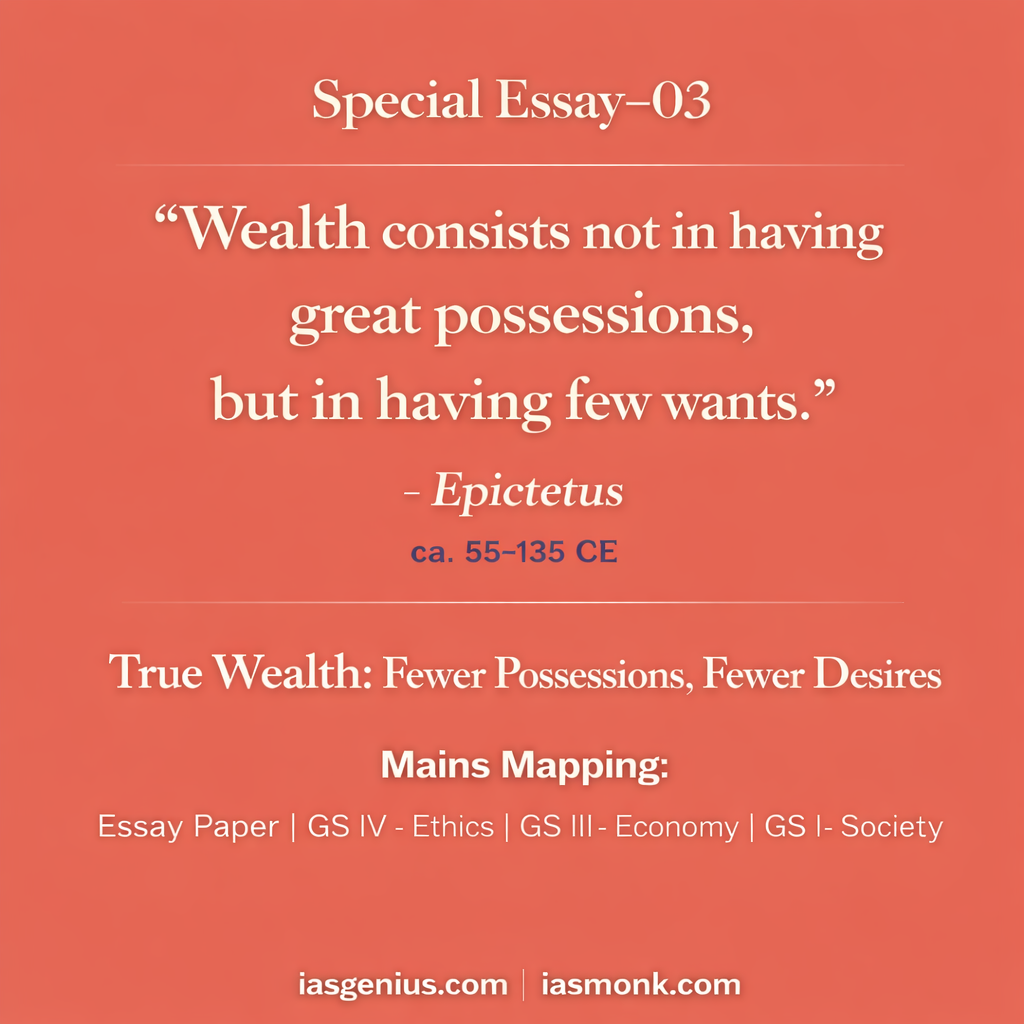
“Wealth Consists Not in Having Great Possessions, but in Having Few Wants” — Epictetus
Introduction: Rethinking Wealth Beyond Possession
In an age defined by consumerism, accumulation, and endless aspiration, the ancient Stoic philosopher Epictetus offers a radically counter-intuitive definition of wealth. Born into slavery and later attaining freedom, Epictetus argued that true wealth does not lie in the abundance of possessions, but in the moderation of desires. His statement — “Wealth consists not in having great possessions, but in having few wants” — strikes at the philosophical core of both economics and ethics.
Far from being a rejection of material life, this idea reframes wealth as a condition of sufficiency, contentment, and control over desire. In modern terms, it aligns closely with economic concepts such as scarcity, utility maximisation, sustainable development, and welfare economics. At its heart, Epictetus’ thought challenges societies to ask a deeper question: Is prosperity about owning more, or about needing less?
Epictetus and the Stoic Conception of Wealth
Epictetus’ philosophy is rooted in Stoicism, which distinguishes sharply between what lies within human control and what does not. According to him, human freedom depends on mastering the former and accepting the latter.
- Within our control: desires, choices, intentions, actions
- Beyond our control: property, wealth, status, health, external events
Material possessions, therefore, are unstable foundations for happiness because they remain subject to chance, loss, and external forces. By contrast, desire regulation is entirely within human control. A person who limits desires ensures that what is attainable is sufficient — thereby achieving contentment regardless of external circumstances.
This idea converts poverty and wealth from economic categories into states of mind. A person with few possessions but fewer desires may be richer than one with vast wealth but limitless wants.
Economic Interpretation: Wants, Scarcity, and Welfare
Modern economics defines itself as the science of allocating scarce resources to satisfy unlimited wants. Epictetus’ insight subtly inverts this assumption. Instead of endlessly expanding resources to meet infinite desires, he suggests reducing desires to align with finite resources.
This has deep implications:
- Utility over accumulation: Welfare depends not on absolute income, but on satisfaction derived from consumption.
- Diminishing marginal utility: Additional possessions yield declining happiness beyond a point.
- Relative deprivation: Wealth measured by comparison fuels dissatisfaction even amid abundance.
Contemporary studies in behavioural economics support this view. Rising incomes beyond basic needs show limited correlation with long-term happiness. The Easterlin Paradox demonstrates that after a threshold, economic growth does not proportionately increase well-being.
Thus, Epictetus anticipates modern welfare economics by centuries — asserting that happiness is demand-side, not supply-side.
Capitalism, Consumerism, and the Culture of Excess
Modern capitalist economies thrive on desire expansion. Advertising, planned obsolescence, and social comparison actively stimulate wants beyond needs. Consumption becomes identity, success, and self-worth.
However, this model generates several pathologies:
- Chronic dissatisfaction despite rising incomes
- Debt-driven consumption and financial stress
- Environmental degradation and resource depletion
- Mental health crises rooted in comparison and insecurity
Epictetus’ philosophy offers a corrective. Instead of endlessly chasing fulfilment through acquisition, he proposes inner autonomy as the foundation of freedom. The person who needs little cannot be coerced, manipulated, or destabilised by material loss.
In this sense, Stoicism becomes a quiet rebellion against consumerist excess.
Indian Civilisational Parallels
Epictetus’ ideas resonate deeply with Indian philosophical traditions.
- Upanishadic thought emphasises contentment (Santosh) over possession.
- Gandhian economics advocates simplicity, trusteeship, and need-based consumption.
- Mahatma Gandhi famously said: “Earth provides enough to satisfy every man’s need, but not every man’s greed.”
India’s traditional ethos viewed wealth (Artha) as legitimate only when balanced by Dharma and Moksha. Unchecked desire (Trishna) was considered the root of suffering.
In this light, Epictetus is not alien to Indian thought — he is philosophically familiar.
Sustainability and Development: Few Wants, Shared Future
In the 21st century, Epictetus’ philosophy acquires urgent relevance through the lens of sustainable development.
- Climate change
- Resource exhaustion
- Ecological imbalance
All stem from overconsumption rather than underproduction. The global crisis is not scarcity of resources, but excess of wants concentrated among a few.
The Sustainable Development Goals (SDGs) implicitly echo Stoic wisdom by advocating:
- Responsible consumption
- Circular economy
- Intergenerational equity
A world that limits wants ensures fairness, ecological balance, and long-term prosperity. In contrast, unlimited consumption by some creates deprivation for others.
Freedom, Ethics, and Inner Wealth
Epictetus ultimately frames wealth as a moral condition. True freedom arises when individuals are no longer enslaved by desire. A person who seeks only what lies within control becomes invulnerable to misfortune.
This ethical insight has modern relevance:
- In governance, it promotes restraint and integrity.
- In economics, it encourages sufficiency over excess.
- In personal life, it fosters resilience and peace.
By shifting the axis of wealth from external possession to internal sufficiency, Epictetus offers a timeless guide to human flourishing.
Conclusion: Redefining Prosperity for the Modern World
Epictetus’ statement is not an argument against wealth, but against misunderstood wealth. It urges societies to redefine prosperity not by what they accumulate, but by what they can live without.
In a world struggling with inequality, ecological crisis, and mental unrest, the wisdom of few wants is not ascetic idealism — it is practical realism. True wealth lies not in multiplying possessions endlessly, but in mastering desire wisely.
As Epictetus reminds us, the richest person is not the one who owns the most, but the one who needs the least.
📌 Mains Booster Section
GS Mapping
- Essay Paper
- GS IV (Ethics): Desire, self-control, happiness
- GS III (Economy): Welfare economics, sustainable development
- GS I (Society): Consumerism and values
10-Mark Answer Framework 1
Q: “Unlimited wants are the root of modern economic and ecological crises.” Discuss.
Intro: Link unlimited wants with scarcity.
Body: Consumerism, environmental stress, inequality.
Conclusion: Need-based growth and ethical restraint.
10-Mark Answer Framework 2
Q: Examine the relevance of Stoic philosophy in contemporary economic thought.
Points:
- Control over desire
- Utility vs accumulation
- Behavioural economics link
15-Mark Answer Framework
Q: “Happiness depends more on regulating desires than expanding resources.” Analyse in the context of sustainable development.
Structure:
- Philosophical basis (Epictetus)
- Economic reasoning
- Environmental implications
- Policy relevance
- Concluding synthesis
IAS Monk Whisper
“A civilisation grows wealthy not when it learns to produce endlessly,
but when it learns to desire wisely.”
Leave a Reply