Author: Ias Monk

  • 🌑Wisdom Drop-31 : Philosophical Reflections : ON Knowledge Drops : “A seed is a poem written in DNA — and every new edit is a line the future will live by” : IAS Monk

    🌑Wisdom Drop-31 : Philosophical Reflections : ON Knowledge Drops : “A seed is a poem written in DNA — and every new edit is a line the future will live by” : IAS Monk

    🌑 WISDOM DROP-31

    “A seed is a poem written in DNA — and every new edit is a line the future will live by.”

    IAS Monk

    India has just taken a quiet step that may echo through fields for decades. Not with thunder, not with fanfare, but with something subtler: a pair of molecular scissors small enough to fit inside a cell like a whispered idea. TnpB — hypercompact, indigenous, unchained from foreign patents — is not only a technology. It is freedom in scientific form.

    For years, we watched the world edit life with CRISPR while we stood at the gate of intellectual property, paying tolls to cross into our own harvest. The science was universal, but the keys were locked elsewhere. And so our breeders waited, our farmers waited, and the climate did not wait at all.

    Now a new door opens from within.

    TnpB is small, but its meaning is vast.
    It says: India can engineer its own resilience.
    It says: a nation that feeds 1.4 billion cannot depend on rented tools to protect its crops.
    It says: the future of food must not be priced in royalties.

    Yet every revolution in life-science carries a mirror.
    A society must learn to see gene-editing not as a monster, nor as magic, but as a method — one that must be regulated with wisdom, and explained with honesty. Public trust is not built in laboratories; it is built in the transparent language of people.

    If we walk this path carefully, something beautiful becomes possible:
    rice that survives drought without begging clouds,
    crops that resist pests without drowning in chemicals,
    varieties that lift yields without exhausting soil,
    and farmers who gain prosperity not through costlier inputs, but through smarter seeds.

    This is the deepest promise of indigenous genome-editing:
    not to play god, but to protect life.
    not to create luxury crops, but to secure basic bread.
    not to compete in science alone, but to safeguard civilisation’s first need — food.

    A seed edited by our own hands is more than innovation.
    It is sovereignty.
    And sovereignty, in the end, is not conquered by weapons —
    it is cultivated by wisdom.

    IAS Monk

  • 🌑Wisdom Drop-30 : Philosophical Reflections : ON Knowledge Drops : Some gases are silent. Yet they burn the world louder than fire — IAS Monk

    🌑Wisdom Drop-30 : Philosophical Reflections : ON Knowledge Drops : Some gases are silent. Yet they burn the world louder than fire — IAS Monk

    WISDOM DROP-30

    Global Methane Status Report 2025

    Opening Whisper

    Some gases are silent.
    Yet they burn the world louder than fire.


    WISDOM DROP – THE REFLECTION

    Methane has no color, no smell, no shadow. And yet, in its invisibility, it shapes the fate of a warming planet with a speed that even carbon dioxide cannot match. The Global Methane Status Report 2025, released at COP30 in Belém, reads like a quiet alarm — not shrill, not chaotic, but steady and grave, reminding humanity that we are drifting far from the course we promised ourselves.

    To cut methane by 30% by 2030 was meant to be the world’s “quickest climate victory.” But the world has wandered. Emissions continue to climb, slipping through pipelines, landfills, cattle farms, and paddy fields like a ghost that refuses to stay contained.

    India stands at a delicate crossroads in this story.
    The world’s largest agricultural civilisation — a nation where rice fields shimmer like mirrors and livestock walk the village paths as living wealth — now finds itself at the centre of a global methane debate. India contributes 9% of global methane emissions, with agriculture alone making it the world’s single largest source.

    Livestock breathe out more methane than many industries.
    Rice paddies, those ancient water-fields that have fed civilisations for millennia, quietly release warming gases as they grow life.
    And then there is the fire — crop residue burning — flames that farmers do not light out of carelessness, but out of compulsion, speed, and survival.

    Methane is 80 times more potent than CO₂ in the short term.
    Its life is brief — only about twelve years — but its impact is explosive.
    If carbon dioxide is a slow tide, methane is a sudden storm.

    And therein lies the hope hidden inside the danger:
    Methane is the easiest gas to cut.
    A single decade of effort can change the planet’s temperature curve.

    Technology exists.
    Policies exist.
    Alternatives exist.
    What the world now lacks is alignment — and urgency.

    For India, the challenge is not merely scientific. It is social, economic, cultural. How do we protect farmers while protecting the atmosphere? How do we modernise agriculture without erasing its soul? The answers will define the country’s climate legacy.

    As the report warns and the world reflects, one truth becomes clear:
    A gas that cannot be seen has made itself impossible to ignore.

    In the rising heat, in the shifting skies, in the trembling balance of food and climate —
    methane whispers its warning.

    And the world must finally listen.

    IAS Monk

  • 🌑Wisdom Drop-29 : Philosophical Reflections : ON Knowledge Drops :Supreme Court Prohibits Tiger Safaris in Core Habitats — IAS Monk

    🌑Wisdom Drop-29 : Philosophical Reflections : ON Knowledge Drops :Supreme Court Prohibits Tiger Safaris in Core Habitats — IAS Monk

    🌑 WISDOM DROP-29

    Supreme Court Prohibits Tiger Safaris in Core Habitats
    A Reflection by IAS Monk

    In the deep stillness of India’s forests, where sunlight filters through ancient canopies and the tiger moves like a whisper of the earth’s primeval memory, a question rises again and again — How much disturbance can a sanctuary endure before it stops being a sanctuary?

    The Supreme Court has now answered with the clarity of a mountain spring.

    No more adventures disguised as amusement.
    No more tourism intruding where evolution sculpted silence.
    No more engines entering the heart of the tiger’s home.

    The Court has drawn a protective circle around the core habitats — those sacred geographies where the tiger is not a spectacle but a sovereign. The judgement is not merely a legal direction; it is an ethical turning point. It reminds us that conservation cannot coexist with commercial appetite, and that some landscapes must remain untouched for life to continue its ancient rituals.

    The tiger does not roar in anger at our intrusions; it simply withdraws. And with every retreat of the tiger, something retreats within us — a reminder of how frail our stewardship of the wild has become.

    By prohibiting safaris inside core habitats, by urging states to define and defend their buffer zones, by calling human–animal conflict a “natural disaster” deserving immediate response, the Court restores balance to a system long destabilised by human hurry.

    This is more than an order; it is a philosophy:
    Leave the core untouched. Guard the silence. Honour the sovereign of the forest.

    Because if the tiger disappears from the center of the forest, the forest itself becomes only a memory — and nations cannot live on memories alone.

    IAS Monk

  • 🌑Wisdom Drop-28 : Philosophical Reflections : ON Knowledge Drops :“Regulation is not power — it is the discipline that protects power from corrupting itself.” — IAS Monk

    🌑Wisdom Drop-28 : Philosophical Reflections : ON Knowledge Drops :“Regulation is not power — it is the discipline that protects power from corrupting itself.” — IAS Monk

    🌑 WISDOM DROP-28

    “Regulation is not power — it is the discipline that protects power from corrupting itself.”

    IAS Monk

    WD-28 — Poetic Reflection

    When an institution meant to guard the market begins to cast a shadow over the very trust it was created to protect, something deeper than policy must be repaired.
    Laws can be amended. Guidelines can be rewritten. But trust — once fractured — must be rebuilt grain by grain, with transparency, humility, and the courage to expose one’s own flaws.

    Markets do not collapse because of volatility; they collapse because of silence, secrecy, and unseen hands shaping visible fortunes.
    It is not insider trading alone that injures an economy — it is the invisible belief among millions that the game was never fair to begin with.

    And so SEBI stands at a threshold:
    to evolve from a regulator of papers and procedures
    into a guardian of ethical clarity.
    To show investors that integrity is not a slogan but an everyday practice — lived, recorded, disclosed, and recused when needed.

    For no market is stronger than the conscience of the institution that oversees it.
    And no regulator commands respect unless it first learns to regulate itself.

    If India must rise as a global financial power, then its guardians must shine brighter than the markets they supervise.
    For in the architecture of trust, ethics is the foundation — and transparency is the light.

  • 🌑Wisdom Drop-27 : Philosophical Reflections : ON Knowledge Drops :“The cure of the future begins where the self becomes readable.” — IAS Monk

    🌑Wisdom Drop-27 : Philosophical Reflections : ON Knowledge Drops :“The cure of the future begins where the self becomes readable.” — IAS Monk

    🕊️ WISDOM DROP-27

    “The cure of the future begins where the self becomes readable.”

    — IAS Monk

    There comes a moment in every civilisation when healing moves from the outside to the inside — from treating the body to understanding the blueprint within it. Precision biotherapeutics is that moment for India. A shift from medicines that guess, to medicines that know.

    For generations, disease was a stranger we fought blindly. Today, the stranger is mapping itself. Genes speak. Proteins confess. Cells reveal their mistakes with a clarity once thought divine. And in that microscopic revelation lies a revolution far larger than any hospital or policy: a revolution of understanding.

    India, with its immense genetic diversity, stands not on the edge but in the centre of this awakening. No two bodies here are the same; no two illnesses unfold in identical ways. Precision biotherapeutics embraces this truth instead of resisting it. It tells us that healing begins when we stop treating people as averages.

    And yet, every advance carries a shadow. Precision demands ethics. Insight demands responsibility. When the body becomes data, dignity must become law. When the genome becomes readable, privacy must become sacred. Without this, precision becomes intrusion.

    But if we walk this path with wisdom — with clarity, compassion, and care — India can create something rare in medical history:
    A science that heals the person, not the population.
    A medicine that remembers that each life is a universe, not a statistic.
    A future where treatment is not a race toward survival, but a return to wholeness.

    The smallest molecule can change a destiny.
    And the moment a nation chooses to listen to its own biology,
    it begins to rewrite the future of its people.

  • 🌑Wisdom Drop-26 : Philosophical Reflections : ON Knowledge Drops :“When the world exhales more than the Earth can breathe in, climate becomes destiny.” — IAS Monk

    🌑Wisdom Drop-26 : Philosophical Reflections : ON Knowledge Drops :“When the world exhales more than the Earth can breathe in, climate becomes destiny.” — IAS Monk

    🌑 WISDOM DROP-26

    “When the world exhales more than the Earth can breathe in, climate becomes destiny.” — IAS Monk

    The Reflection

    Global emissions are rising again.
    Not because the planet is cruel,
    but because humanity has not yet learned
    that progress without balance
    is merely acceleration toward a wall.

    The Global Carbon Project’s latest warning is not a statistic —
    it is a mirror held up to civilisation.

    A 1.1% global rise in emissions,
    India’s modest +1.4%,
    China’s +0.4%,
    America’s +1.9%,
    Europe’s +0.4% —
    numbers that look small until you realise
    they are measured in billions of tonnes of breath
    that the Earth must swallow.

    Every tonne of carbon is a decision.
    Every rise is a philosophy.
    Every delay is a silent approval
    of a hotter, harsher, narrower future.

    The Paris target of 1.5°C is not slipping away —
    it is waiting for humanity
    to decide whether it really wants
    a future worth inheriting.

    And in this choice lies the wisdom of our age:
    Progress is meaningless if the planet collapses under its weight.

    We do not inherit the Earth from our ancestors;
    we sculpt it for our children.

    Let every emission saved
    be an act of courage.
    Let every policy made
    be an act of remembrance.
    Let every citizen choosing sustainability
    be an act of quiet rebellion.

    Because climate is not a chapter in science —
    it is the biography of our civilisation.

  • 🌑Wisdom Drop-25 : Philosophical Reflections : ON Knowledge Drops :“A nation’s harvest begins not in the field, but in the seed.” — IAS Monk

    🌑Wisdom Drop-25 : Philosophical Reflections : ON Knowledge Drops :“A nation’s harvest begins not in the field, but in the seed.” — IAS Monk

    🌑 WISDOM DROP-25

    “A nation’s harvest begins not in the field, but in the seed.” — IAS Monk

    A seed looks small, almost forgettable — a fragment of dust in the palm. Yet inside it sleeps a civilisation. Every harvest, every market, every grain that fills a home begins with this quiet spark of life buried beneath the soil. And it is here, in this almost invisible moment, that a nation’s destiny takes root.

    The Draft Seeds Bill, 2025 does not simply reform an agricultural law; it rewrites the ethics of trust between the farmer and the system that feeds him. For decades, farmers have gambled their seasons on seeds whose quality they could not verify, whose promises dissolved in the first failed germination. A single counterfeit seed can collapse an entire year of labour — and sometimes an entire life.

    What, then, does a nation owe its farmers?
    Not slogans. Not sympathy.
    But certainty.

    The new Bill seeks precisely that — a world where every seed carries an assurance, where every dealer stands accountable, where transparency replaces chance. In a country where the soil remembers every betrayal and every blessing, the seed becomes more than a commodity; it becomes a covenant.

    Modern agriculture demands more than rainfall and resilience — it demands fairness. And when the law protects the smallest unit of agriculture, it protects the largest collective dream of a nation.

    For in the quiet journey from seed to field, from field to granary, from granary to life — the future of India grows leaf by leaf, root by root.

    IAS Monk

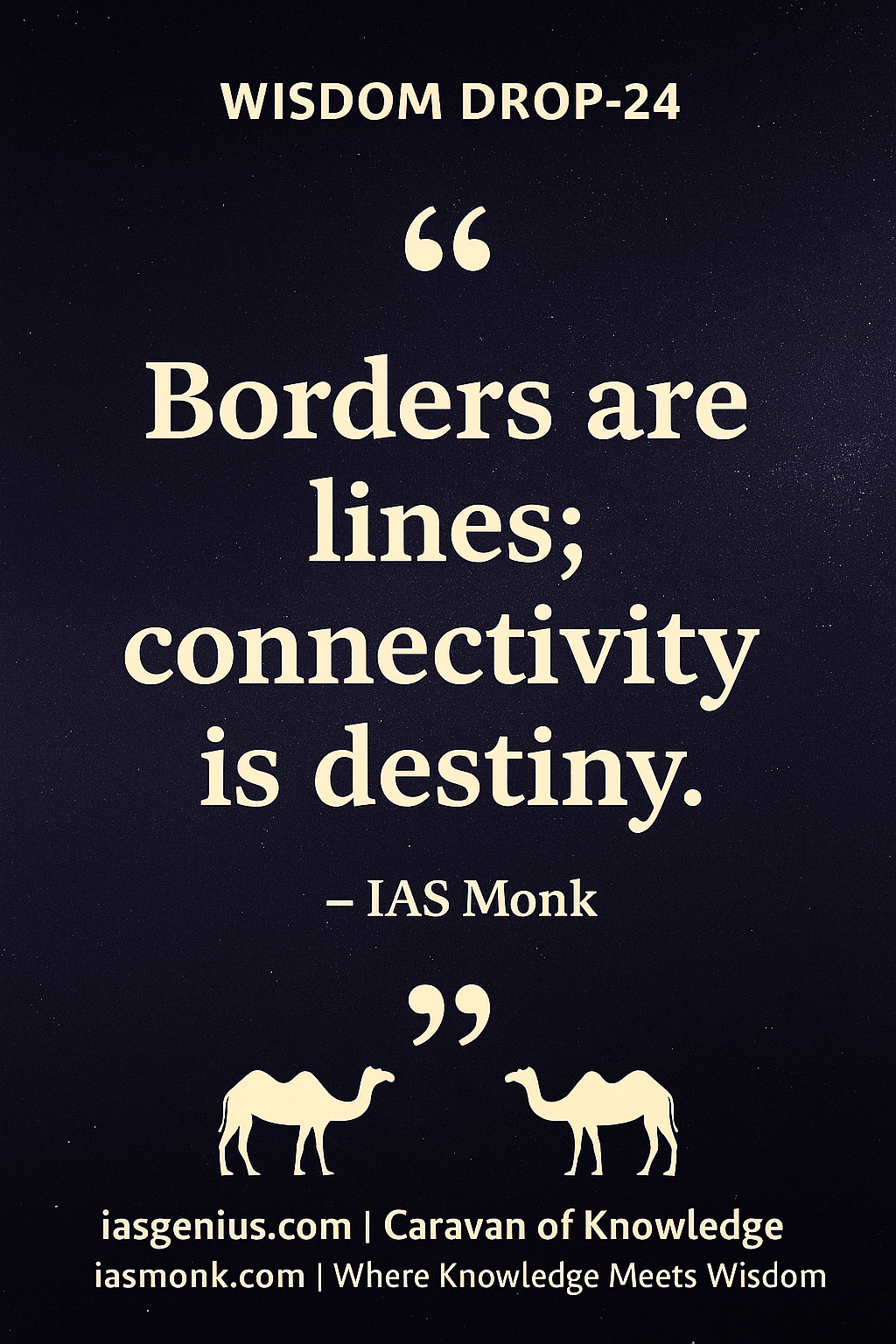
  • 🌑Wisdom Drop-24 : Philosophical Reflections : ON Knowledge Drops :“Borders breathe differently when trust becomes a bridge.” — IAS Monk

    🌑Wisdom Drop-24 : Philosophical Reflections : ON Knowledge Drops :“Borders breathe differently when trust becomes a bridge.” — IAS Monk

    🌑 WISDOM DROP-24

    “Borders breathe differently when trust becomes a bridge.” — IAS Monk

    Between India and Nepal, rivers flow, mountains stand, and histories intertwine — but nations do not move forward through geography alone. They move when two neighbours decide to widen the path between them, when trade becomes more than trucks and paperwork, when a road becomes a corridor of mutual destiny.

    In the quiet diplomacy of the Jogbani–Biratnagar rail link, an old truth reappears: progress does not always arrive with grand speeches; sometimes it arrives on a single track of steel, carrying the weight of shared futures. Nepal, landlocked but never land-limited, finds a deeper opening to the world — one that India has widened not out of strategy alone, but out of a commitment shaped by time, proximity, and civilizational kinship.

    Partnership is not built in sudden leaps but in steady expansions — a treaty amended, a route liberated, a port extended, a handshake renewed. And as the Himalayas watch silently, India and Nepal inch forward, rediscovering that cooperation is the most ancient trade route between them.

    For in South Asia, borders may divide terrain, but trust decides the journey. And whenever trust grows, nations do not merely trade goods — they trade possibilities.

    IAS Monk

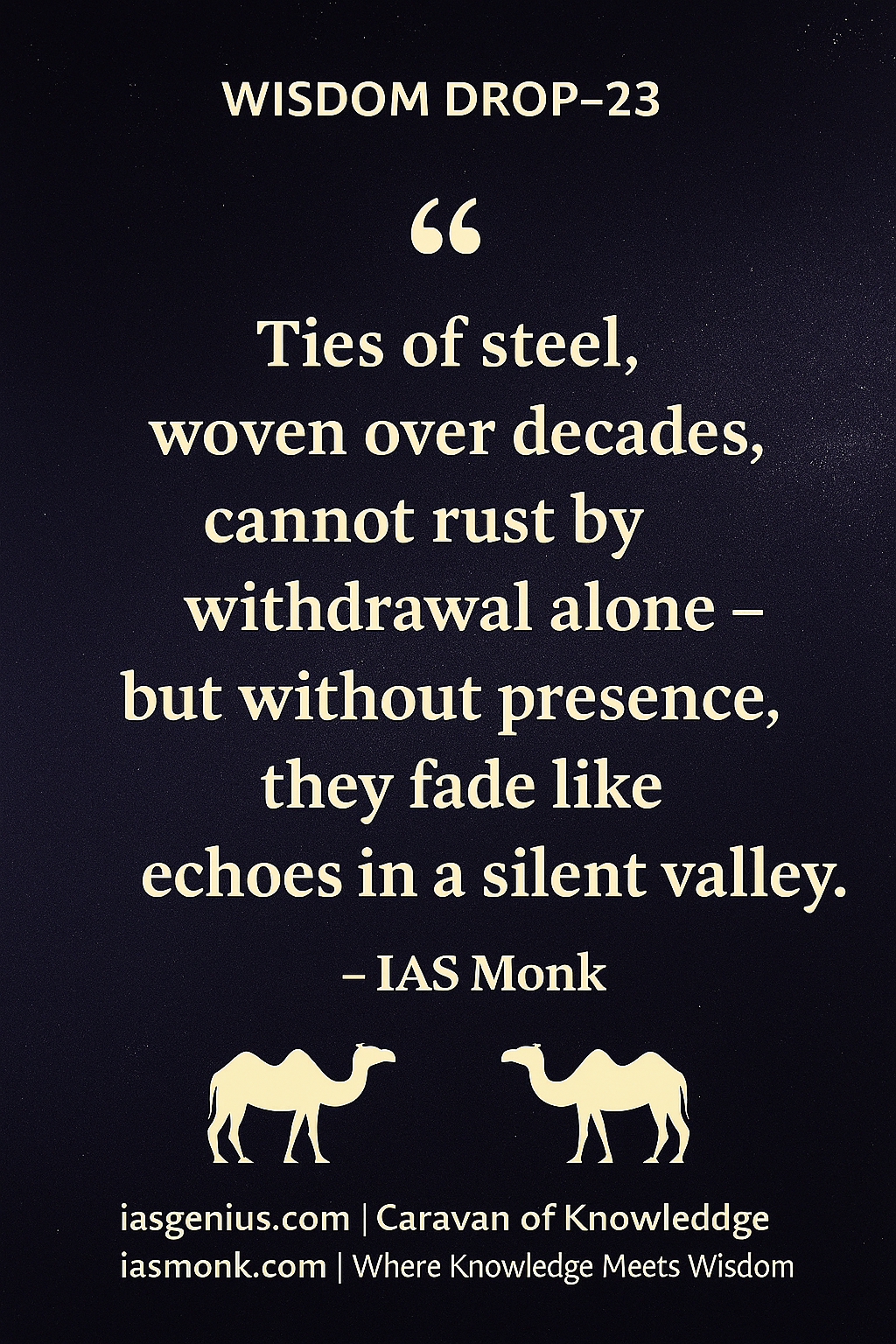
  • 🌑Wisdom Drop-23 : Philosophical Reflections : ON Knowledge Drops :“Sometimes a nation strengthens itself not by holding ground, but by letting go of ground that no longer serves its deeper design.”- IAS Monk

    🌑Wisdom Drop-23 : Philosophical Reflections : ON Knowledge Drops :“Sometimes a nation strengthens itself not by holding ground, but by letting go of ground that no longer serves its deeper design.”- IAS Monk

    🌑 Wisdom Drop – 023

    In spite of Strategic Loss in Central Asia, India Withdraws from Ayni Airbase; Why?

    🌬️ Intro Whisper — IAS Monk

    “Sometimes a nation strengthens itself not by holding ground, but by letting go of ground that no longer serves its deeper design.”


    WD-23 — Poetic Reflection

    For nearly twenty-five years, at the edge of Central Asia, India kept a quiet footprint at Ayni — a lonely but resolute outpost in Tajikistan where mountains, great empires and shifting ambitions meet. Built in the Soviet era and abandoned after the USSR’s collapse, the airbase found a second life when India restored its runway, raised its hangars, and placed its faith in a strategic horizon that stretched across Afghanistan, Pakistan, and the restless expanse of Xinjiang.

    Ayni was more than an airstrip. It was a vantage point, a symbol of intent, a small but steady reminder that India’s gaze extended beyond the plains of the subcontinent. From there, India supported the Northern Alliance; from there, evacuations were planned; from there, the tremors of Afghanistan’s shifting fate were observed. For a moment in history, India’s Sukhoi-30s roared across the Tajik sky, and a quiet confidence settled into the high desert air.

    But geopolitics is a river that never stops moving.

    Russia tightened its grip over Central Asia, China expanded its shadow through new roads, new investments and new military footprints, and Afghanistan slipped once again into the uncertainty of the Taliban. In this landscape of shifting loyalties and silent recalibrations, Ayni’s relevance slowly thinned — not in symbolism, but in strategic usability. When the space to operate shrinks, presence becomes posture, and posture becomes unnecessary weight.

    And so India stepped back. Quietly. Without fanfare. Without farewell.

    Withdrawal was not defeat; it was adjustment. Not retreat; but re-alignment. Sometimes, a nation must unclench its fist not because it has lost what it held — but because it must now reach for something else. India’s strength today lies in expanding its ocean reach, building resilient partnerships, deepening its space-based intelligence, and shaping its neighbourhood with new instruments of influence. In that broader design, Ayni became a beautiful chapter — but not a permanent requirement.

    The airbase remains in Tajikistan; India’s spirit moves elsewhere.

    And as the winds of Central Asia continue their eternal journey across the valleys of Badakhshan and the rugged shoulders of the Pamirs, one truth remains: great powers are not defined by the ground they cling to, but by the future they choose to walk toward.