Category: Wisdom Drops

Philosophical Reflections on Knowledge Drops of IAS Genius.com by IAS Monk

  • 🌑Wisdom Drop-36 : Philosophical Reflections : ON Knowledge Drops : “When Justice Walks, a Nation Begins to Breathe” : IAS Monk

    🌑Wisdom Drop-36 : Philosophical Reflections : ON Knowledge Drops : “When Justice Walks, a Nation Begins to Breathe” : IAS Monk

    🌾 Wisdom Drop-36

    “When Justice Walks, a Nation Begins to Breathe”

    (A Poetic Wisdom Drop inspired by the ascent of Justice Surya Kant, 53rd Chief Justice of India)

    There are moments in a nation’s life
    when a single oath echoes louder than the crowd,
    when a quiet signature becomes a shield
    for millions who may never see the judge,
    yet feel the warmth of his justice.

    Justice does not arrive with sirens.
    It walks barefoot,
    carrying the dust of every unheard voice,
    entering the courtroom with a lantern
    lit by the Constitution itself.

    Some judges read the law.
    Others listen to the silences between the lines.
    And once in a rare while,
    a judge carries both the burden of duty
    and the softness of understanding.

    When Justice Surya Kant stepped forward
    to take the oath as India’s 53rd Chief Justice,
    the Constitution did not merely gain a custodian—
    it gained a listener.

    A listener who knows
    that arrears are not just numbers,
    but human stories waiting at the door.
    That reforms are not just paragraphs,
    but rivers that must be redirected towards fairness.
    That power is not a throne,
    but a responsibility to the unseen.

    For justice is not a gavel—
    it is a breath.
    A breath that must never be delayed,
    never be silenced,
    never be surrendered.

    And perhaps the greatest wisdom is this:
    A nation is not judged by its laws,
    but by the courage of the hands that uphold them.

    May his tenure remind us
    that democracies do not survive on elections alone,
    but on the integrity of those
    who safeguard the Constitution
    when no one is watching.

    For when justice walks with humility,
    a nation begins to breathe again.

    IAS Monk

  • 🌑Wisdom Drop-35 : Philosophical Reflections : ON Knowledge Drops : IBSA: Three Continents, One Quiet Bridge : IAS Monk

    🌑Wisdom Drop-35 : Philosophical Reflections : ON Knowledge Drops : IBSA: Three Continents, One Quiet Bridge : IAS Monk

    🌿 Wisdom Drop-35

    IBSA: Three Continents, One Quiet Bridge

    There are moments in history when nations do not meet as governments, but as memories. India, Brazil, and South Africa — three distant shores — once carried the weight of different storms, yet today they stand like three ancient trees whose roots have finally found each other beneath the soil of the world.

    And when leaders lean in, not to argue but to listen, the world pauses. It pauses because three democracies are whispering their way through the noise of a fractured planet. It pauses because unity is no longer a slogan — it is a fragile lamp held by hands that have known darkness.

    IBSA is not a forum. It is geography learning to breathe together. It is Asia remembering that the Atlantic is not far, and Africa realizing that the Indian Ocean has always been a bridge. It is the rediscovery that continents move not by tectonics alone, but by courage, alignment, and trust.

    When Modi, Lula, and Ramaphosa stand shoulder to shoulder, it is not merely diplomacy. It is a reminder that history is carried in voices, and that wounds heal when nations choose conversation over caution, and cooperation over pride.

    And somewhere in the quiet of the Johannesburg air, one can almost hear another truth — that unity is strongest among those who have suffered inequality, injustice, and invisibility. That the Global South does not rise by anger but by alignment. That reform of the world’s institutions begins not with declarations, but with the decision to walk together.

    Terror cannot be fought by fragmented voices. Poverty cannot be challenged by isolated islands. Digital futures cannot be built behind closed borders. And climate resilience cannot emerge from nations that refuse to share their rain.

    So IBSA becomes a lantern — small, but steady — reminding the world that three democracies, far apart on the map, can still find a single rhythm. A rhythm made of shared hunger for justice, shared impatience with outdated structures, and shared faith that the world’s fractures can be mended by hands that refuse to let go.

    And if one listens deeply, beneath the speeches and the formalities, there is a softer message waiting to be heard:

    That the world is not changed by the powerful,
    but by the persistent.
    Not by the loud,
    but by the aligned.
    Not by giants,
    but by companions who look at each other and say,
    “Let us carry this together.”

    IBSA is not the alliance of three nations.
    It is the bridge where continents learn humility,
    and where humanity rediscovers its courage.

    IAS Monk 🌿

  • 🌑Wisdom Drop-34 : Philosophical Reflections : ON Knowledge Drops : G20 South Africa: “When nations gather, it is not their flags that speak first — it is their histories.” : IAS Monk

    🌑Wisdom Drop-34 : Philosophical Reflections : ON Knowledge Drops : G20 South Africa: “When nations gather, it is not their flags that speak first — it is their histories.” : IAS Monk

    WISDOM DROP – 34

    “When nations gather, it is not their flags that speak first — it is their histories.”

    There are summits where leaders arrive with files, protocols, and practiced smiles.
    And then there are rare moments when a nation arrives carrying its memory, its wounds, and its quiet strength.
    Johannesburg, November 2025, was such a moment for India.

    As the Prime Minister stepped onto African soil, it felt less like diplomacy and more like a homecoming across the Indian Ocean — two civilizations meeting not as strangers, but as survivors of centuries that tried to silence them. Africa welcomed the G20 for the first time. And in that welcome lay a truth the world often forgets: the future cannot be written without those who have carried the heaviest burdens of the past.

    At the summit, India did not speak with the arrogance of power, nor with the timidity of hesitation.
    It spoke with something older — a civilizational stillness that comes from knowing that the world has always moved forward when humanity remembered its shared soul.

    “One Earth, One Family, One Future” — a phrase that could have been dismissed as idealism — suddenly glowed brighter under an African sky. For Africa knows what it means to rebuild from ashes. And India knows what it means to rise after centuries of being pushed down. Their destinies have long echoed each other like two drums beating the same ancient rhythm.

    Johannesburg also revealed the fractures of our times.
    A summit overshadowed by boycotts, disagreements, and a world drifting into hardened blocs.
    But even in the tension, India held its ground — not as a disruptor, but as a bridge.
    A bridge between continents, between histories, between futures.

    The summit was more than negotiations; it was a mirror.
    It reminded the world that leadership today is not measured by GDP alone, but by the capacity to care, to include, to uplift, and to listen.

    In quiet corridors and crowded halls, India stood beside Africa not as a benefactor, but as a partner.
    Assisting in food security, global alliances against hunger, digital welfare models, development financing — the work was not glamorous, but essential.
    Sometimes true leadership is nothing more than steady hands holding one corner of the world so that the rest can breathe.

    As the summit ended, Johannesburg felt like a doorway — not an exit.
    A doorway into a future where global tables widen, where old hierarchies loosen, where every nation, large or small, is given space to speak and space to dream.

    And in that unfolding future, India’s role is no longer to merely participate.
    It is to remind the world of a forgotten truth:

    That humanity moves forward not through dominance, but through dignity.
    Not through isolation, but through kinship.
    Not through competition, but through compassion.

    The G20 in South Africa was not a gathering of powers.
    It was a gathering of possibilities.
    And India walked among them with the humility of a monk, the confidence of a civilization, and the hope of a billion hearts asking the world to walk together.

  • 🌑Wisdom Drop-33 : Philosophical Reflections : ON Knowledge Drops : “When power leans, justice must remember how to stand.” : IAS Monk

    🌑Wisdom Drop-33 : Philosophical Reflections : ON Knowledge Drops : “When power leans, justice must remember how to stand.” : IAS Monk

    WISDOM DROP-33

    “When power leans, justice must remember how to stand.”

    (IAS Monk — Poetic Reflection drawn from KD-33)

    There are moments in a nation’s story when a single judge becomes not just an interpreter of law,
    but a mirror — reflecting the quiet tremors inside the republic.

    CJI Bhushan R. Gavai’s tenure was short, but like a sudden monsoon in a parched land,
    its impact was felt in the dust, the leaves, the stones,
    and in the way the air itself began to think differently.

    He came from the margins —
    from the long corridors where voices often echo unheard.
    And when he sat on the highest seat,
    he carried that echo with him.
    He carried it into judgments,
    into late-night bail orders,
    into warnings against bulldozers masquerading as justice,
    into his belief that the Constitution is not a shield for the powerful
    but a shelter for the trembling.

    Sometimes he stood firm,
    sometimes the institution shook beneath him,
    and sometimes the very structure of judicial power revealed its cracks.
    But that is what truth does:
    it shows itself not only in triumphs
    but in the uncomfortable shadows of decision-making.

    A tenure is not remembered by length.
    It is remembered by the way it teaches a nation
    to rethink its own conscience.

    And so, WD-33 whispers this subtle truth:
    When a judge carries both history and humility,
    the law learns to breathe again.

    Justice is never a straight line.
    It bends with society,
    it stretches toward the future,
    it contracts under pressure,
    it opens under courage.

    But when someone who has walked through the margins
    rises to interpret the center,
    the Constitution becomes not a document —
    but a living act of remembrance.

    For in the end,
    what remains of a Chief Justice
    is not the orders he signed,
    nor the controversies he endured,
    but the faint tremor he leaves in the nation’s moral geometry.

    Some legacies are loud.
    Some legacies walk barefoot.
    This one does both —
    and leaves a quiet, dignified footprint on the sands of Indian justice.

    — IAS Monk


  • 🌑Wisdom Drop-32 : Philosophical Reflections : ON Knowledge Drops : “When nations argue, the climate does not wait — the forests do not pause for drafts, and the glaciers do not negotiate.” : IAS Monk

    🌑Wisdom Drop-32 : Philosophical Reflections : ON Knowledge Drops : “When nations argue, the climate does not wait — the forests do not pause for drafts, and the glaciers do not negotiate.” : IAS Monk

    🌑 WISDOM DROP-32

    “When nations argue, the climate does not wait — the forests do not pause for drafts, and the glaciers do not negotiate.”

    IAS Monk

    Reflection on COP 30:

    COP30 ends not like a symphony, but like a meeting that ran out of breath.
    The Amazon stood outside the negotiation halls like an ancient guardian, breathing its damp green wisdom into the air, yet inside the halls of Belém the world’s nations remained divided — not by science, but by fear, by responsibility, by the price of doing what is right.

    A summit that hoped to heal ended up revealing wounds.

    The world arrived in Brazil expecting unity and instead found mirrors —
    each country reflecting its own anxieties: energy security, economic survival, historic blame, political contest. And somewhere between these lines, the planet’s fever continued to rise.

    There was no agreement on fossil fuels.
    No harmony on finance.
    No clarity on who must do what first.
    Only the silent reminder that climate physics does not care for political paragraphs.

    And yet, even in disagreement, COP30 left sparks glowing in the dark:

    A health plan that sees climate not as an abstract threat, but as an illness that strikes lungs, crops, and the future of children.
    A facility that rewards nations for guarding forests with satellites instead of chainsaws.
    A digital nervous system meant to unify fragmented climate data into a shared planetary intelligence.
    A pledge to reimagine fuels, not as the energy of the past but as bridges to a gentler future.
    And declarations that place hunger, poverty and human dignity at the center of climate action.

    The Amazon — vast, breathing, wounded — watched the world fail to agree on how quickly it must be saved. But the forest also knows a truth older than civilisation:
    that change does not begin when every voice aligns;
    it begins when even one voice refuses to turn away.

    India stood in Belém with the weight of the Global South behind it —
    insisting on climate justice,
    resisting unfair trade barriers,
    calling for predictable finance,
    refusing to let the poorest nations pay for the richest emissions.

    The negotiations remain unfinished. But the planet’s story never pauses for signatures. Rainforests do not follow deadlines. Methane does not wait for commas. Melting ice does not stop because the room needs “more time.”

    Yet wisdom lies not in despair —
    but in recognising that every unresolved summit is a reminder that the responsibility returns to us, again and again, every dawn.

    Climate action is not a treaty.
    It is a practice.
    A discipline.
    A moral choice repeated daily.

    As COP30 disperses into the humid air of Belém, one truth rings quietly:

    If we fail to agree on the future, the future will decide for us.

    IAS Monk

  • 🌑Wisdom Drop-31 : Philosophical Reflections : ON Knowledge Drops : “A seed is a poem written in DNA — and every new edit is a line the future will live by” : IAS Monk

    🌑Wisdom Drop-31 : Philosophical Reflections : ON Knowledge Drops : “A seed is a poem written in DNA — and every new edit is a line the future will live by” : IAS Monk

    🌑 WISDOM DROP-31

    “A seed is a poem written in DNA — and every new edit is a line the future will live by.”

    IAS Monk

    India has just taken a quiet step that may echo through fields for decades. Not with thunder, not with fanfare, but with something subtler: a pair of molecular scissors small enough to fit inside a cell like a whispered idea. TnpB — hypercompact, indigenous, unchained from foreign patents — is not only a technology. It is freedom in scientific form.

    For years, we watched the world edit life with CRISPR while we stood at the gate of intellectual property, paying tolls to cross into our own harvest. The science was universal, but the keys were locked elsewhere. And so our breeders waited, our farmers waited, and the climate did not wait at all.

    Now a new door opens from within.

    TnpB is small, but its meaning is vast.
    It says: India can engineer its own resilience.
    It says: a nation that feeds 1.4 billion cannot depend on rented tools to protect its crops.
    It says: the future of food must not be priced in royalties.

    Yet every revolution in life-science carries a mirror.
    A society must learn to see gene-editing not as a monster, nor as magic, but as a method — one that must be regulated with wisdom, and explained with honesty. Public trust is not built in laboratories; it is built in the transparent language of people.

    If we walk this path carefully, something beautiful becomes possible:
    rice that survives drought without begging clouds,
    crops that resist pests without drowning in chemicals,
    varieties that lift yields without exhausting soil,
    and farmers who gain prosperity not through costlier inputs, but through smarter seeds.

    This is the deepest promise of indigenous genome-editing:
    not to play god, but to protect life.
    not to create luxury crops, but to secure basic bread.
    not to compete in science alone, but to safeguard civilisation’s first need — food.

    A seed edited by our own hands is more than innovation.
    It is sovereignty.
    And sovereignty, in the end, is not conquered by weapons —
    it is cultivated by wisdom.

    IAS Monk

  • 🌑Wisdom Drop-30 : Philosophical Reflections : ON Knowledge Drops : Some gases are silent. Yet they burn the world louder than fire — IAS Monk

    🌑Wisdom Drop-30 : Philosophical Reflections : ON Knowledge Drops : Some gases are silent. Yet they burn the world louder than fire — IAS Monk

    WISDOM DROP-30

    Global Methane Status Report 2025

    Opening Whisper

    Some gases are silent.
    Yet they burn the world louder than fire.


    WISDOM DROP – THE REFLECTION

    Methane has no color, no smell, no shadow. And yet, in its invisibility, it shapes the fate of a warming planet with a speed that even carbon dioxide cannot match. The Global Methane Status Report 2025, released at COP30 in Belém, reads like a quiet alarm — not shrill, not chaotic, but steady and grave, reminding humanity that we are drifting far from the course we promised ourselves.

    To cut methane by 30% by 2030 was meant to be the world’s “quickest climate victory.” But the world has wandered. Emissions continue to climb, slipping through pipelines, landfills, cattle farms, and paddy fields like a ghost that refuses to stay contained.

    India stands at a delicate crossroads in this story.
    The world’s largest agricultural civilisation — a nation where rice fields shimmer like mirrors and livestock walk the village paths as living wealth — now finds itself at the centre of a global methane debate. India contributes 9% of global methane emissions, with agriculture alone making it the world’s single largest source.

    Livestock breathe out more methane than many industries.
    Rice paddies, those ancient water-fields that have fed civilisations for millennia, quietly release warming gases as they grow life.
    And then there is the fire — crop residue burning — flames that farmers do not light out of carelessness, but out of compulsion, speed, and survival.

    Methane is 80 times more potent than CO₂ in the short term.
    Its life is brief — only about twelve years — but its impact is explosive.
    If carbon dioxide is a slow tide, methane is a sudden storm.

    And therein lies the hope hidden inside the danger:
    Methane is the easiest gas to cut.
    A single decade of effort can change the planet’s temperature curve.

    Technology exists.
    Policies exist.
    Alternatives exist.
    What the world now lacks is alignment — and urgency.

    For India, the challenge is not merely scientific. It is social, economic, cultural. How do we protect farmers while protecting the atmosphere? How do we modernise agriculture without erasing its soul? The answers will define the country’s climate legacy.

    As the report warns and the world reflects, one truth becomes clear:
    A gas that cannot be seen has made itself impossible to ignore.

    In the rising heat, in the shifting skies, in the trembling balance of food and climate —
    methane whispers its warning.

    And the world must finally listen.

    IAS Monk

  • 🌑Wisdom Drop-29 : Philosophical Reflections : ON Knowledge Drops :Supreme Court Prohibits Tiger Safaris in Core Habitats — IAS Monk

    🌑Wisdom Drop-29 : Philosophical Reflections : ON Knowledge Drops :Supreme Court Prohibits Tiger Safaris in Core Habitats — IAS Monk

    🌑 WISDOM DROP-29

    Supreme Court Prohibits Tiger Safaris in Core Habitats
    A Reflection by IAS Monk

    In the deep stillness of India’s forests, where sunlight filters through ancient canopies and the tiger moves like a whisper of the earth’s primeval memory, a question rises again and again — How much disturbance can a sanctuary endure before it stops being a sanctuary?

    The Supreme Court has now answered with the clarity of a mountain spring.

    No more adventures disguised as amusement.
    No more tourism intruding where evolution sculpted silence.
    No more engines entering the heart of the tiger’s home.

    The Court has drawn a protective circle around the core habitats — those sacred geographies where the tiger is not a spectacle but a sovereign. The judgement is not merely a legal direction; it is an ethical turning point. It reminds us that conservation cannot coexist with commercial appetite, and that some landscapes must remain untouched for life to continue its ancient rituals.

    The tiger does not roar in anger at our intrusions; it simply withdraws. And with every retreat of the tiger, something retreats within us — a reminder of how frail our stewardship of the wild has become.

    By prohibiting safaris inside core habitats, by urging states to define and defend their buffer zones, by calling human–animal conflict a “natural disaster” deserving immediate response, the Court restores balance to a system long destabilised by human hurry.

    This is more than an order; it is a philosophy:
    Leave the core untouched. Guard the silence. Honour the sovereign of the forest.

    Because if the tiger disappears from the center of the forest, the forest itself becomes only a memory — and nations cannot live on memories alone.

    IAS Monk

  • 🌑Wisdom Drop-28 : Philosophical Reflections : ON Knowledge Drops :“Regulation is not power — it is the discipline that protects power from corrupting itself.” — IAS Monk

    🌑Wisdom Drop-28 : Philosophical Reflections : ON Knowledge Drops :“Regulation is not power — it is the discipline that protects power from corrupting itself.” — IAS Monk

    🌑 WISDOM DROP-28

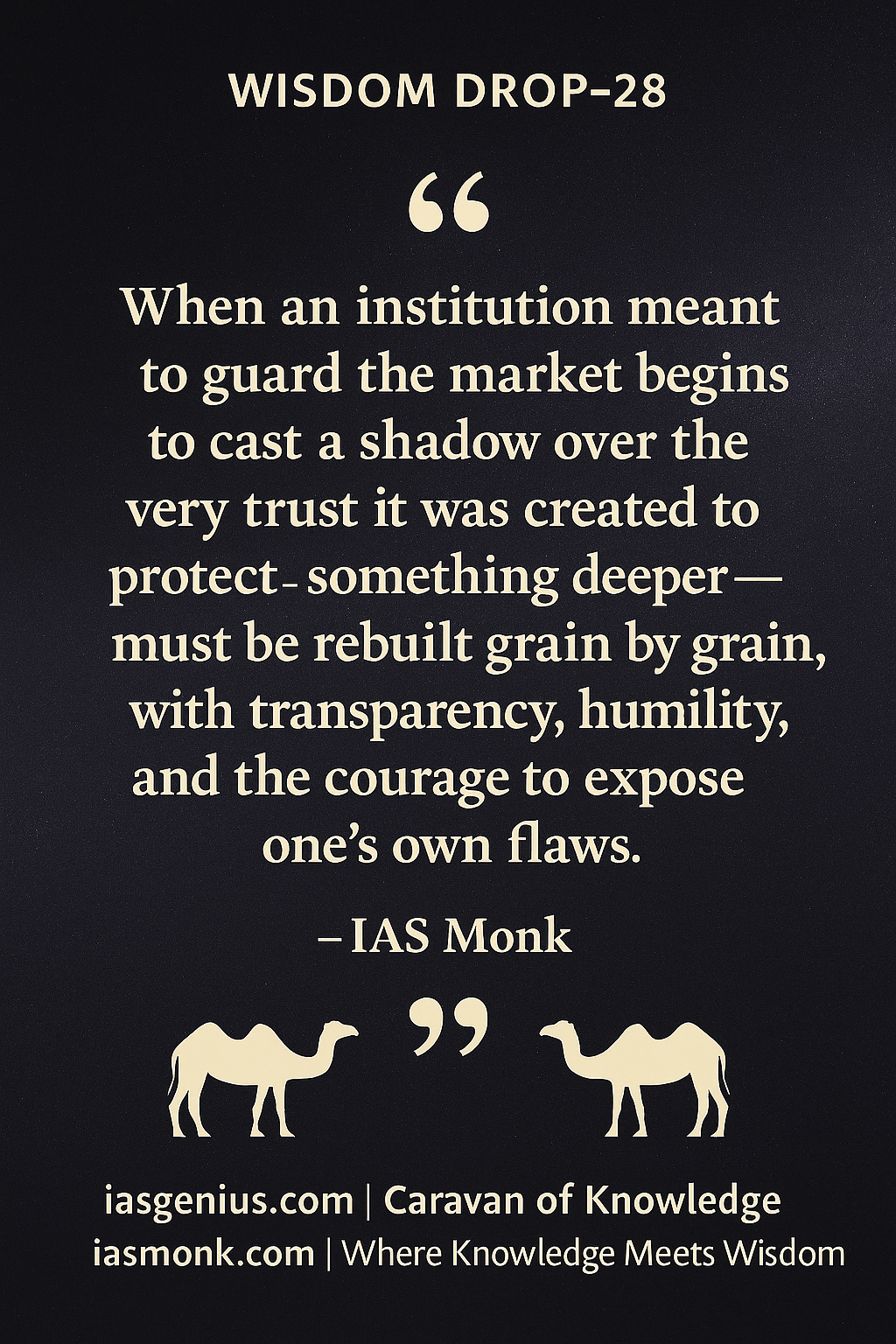
    “Regulation is not power — it is the discipline that protects power from corrupting itself.”

    IAS Monk

    WD-28 — Poetic Reflection

    When an institution meant to guard the market begins to cast a shadow over the very trust it was created to protect, something deeper than policy must be repaired.
    Laws can be amended. Guidelines can be rewritten. But trust — once fractured — must be rebuilt grain by grain, with transparency, humility, and the courage to expose one’s own flaws.

    Markets do not collapse because of volatility; they collapse because of silence, secrecy, and unseen hands shaping visible fortunes.
    It is not insider trading alone that injures an economy — it is the invisible belief among millions that the game was never fair to begin with.

    And so SEBI stands at a threshold:
    to evolve from a regulator of papers and procedures
    into a guardian of ethical clarity.
    To show investors that integrity is not a slogan but an everyday practice — lived, recorded, disclosed, and recused when needed.

    For no market is stronger than the conscience of the institution that oversees it.
    And no regulator commands respect unless it first learns to regulate itself.

    If India must rise as a global financial power, then its guardians must shine brighter than the markets they supervise.
    For in the architecture of trust, ethics is the foundation — and transparency is the light.