Category: Wisdom Drops

Philosophical Reflections on Knowledge Drops of IAS Genius.com by IAS Monk

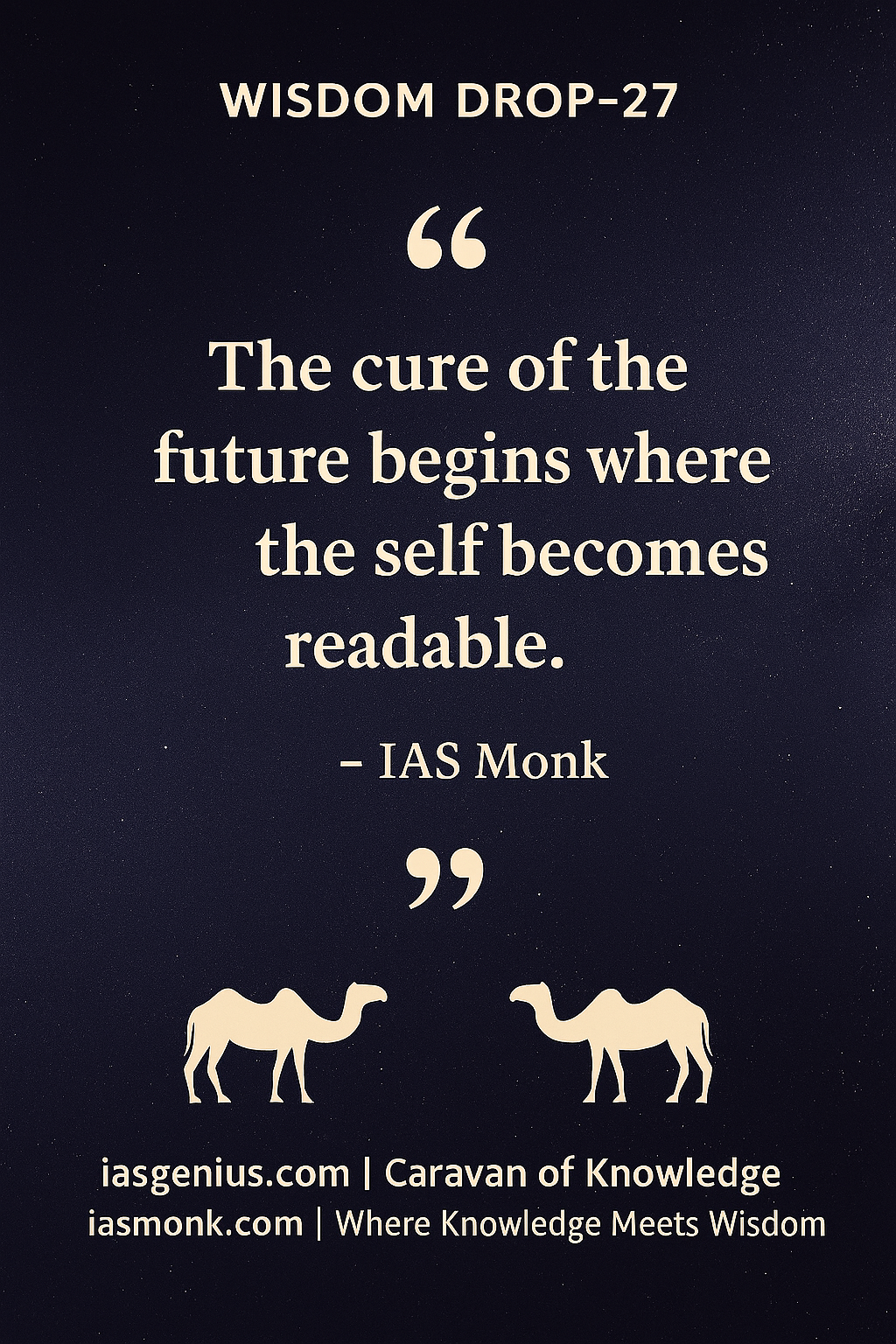
  • 🌑Wisdom Drop-27 : Philosophical Reflections : ON Knowledge Drops :“The cure of the future begins where the self becomes readable.” — IAS Monk

    🌑Wisdom Drop-27 : Philosophical Reflections : ON Knowledge Drops :“The cure of the future begins where the self becomes readable.” — IAS Monk

    🕊️ WISDOM DROP-27

    “The cure of the future begins where the self becomes readable.”

    — IAS Monk

    There comes a moment in every civilisation when healing moves from the outside to the inside — from treating the body to understanding the blueprint within it. Precision biotherapeutics is that moment for India. A shift from medicines that guess, to medicines that know.

    For generations, disease was a stranger we fought blindly. Today, the stranger is mapping itself. Genes speak. Proteins confess. Cells reveal their mistakes with a clarity once thought divine. And in that microscopic revelation lies a revolution far larger than any hospital or policy: a revolution of understanding.

    India, with its immense genetic diversity, stands not on the edge but in the centre of this awakening. No two bodies here are the same; no two illnesses unfold in identical ways. Precision biotherapeutics embraces this truth instead of resisting it. It tells us that healing begins when we stop treating people as averages.

    And yet, every advance carries a shadow. Precision demands ethics. Insight demands responsibility. When the body becomes data, dignity must become law. When the genome becomes readable, privacy must become sacred. Without this, precision becomes intrusion.

    But if we walk this path with wisdom — with clarity, compassion, and care — India can create something rare in medical history:
    A science that heals the person, not the population.
    A medicine that remembers that each life is a universe, not a statistic.
    A future where treatment is not a race toward survival, but a return to wholeness.

    The smallest molecule can change a destiny.
    And the moment a nation chooses to listen to its own biology,
    it begins to rewrite the future of its people.
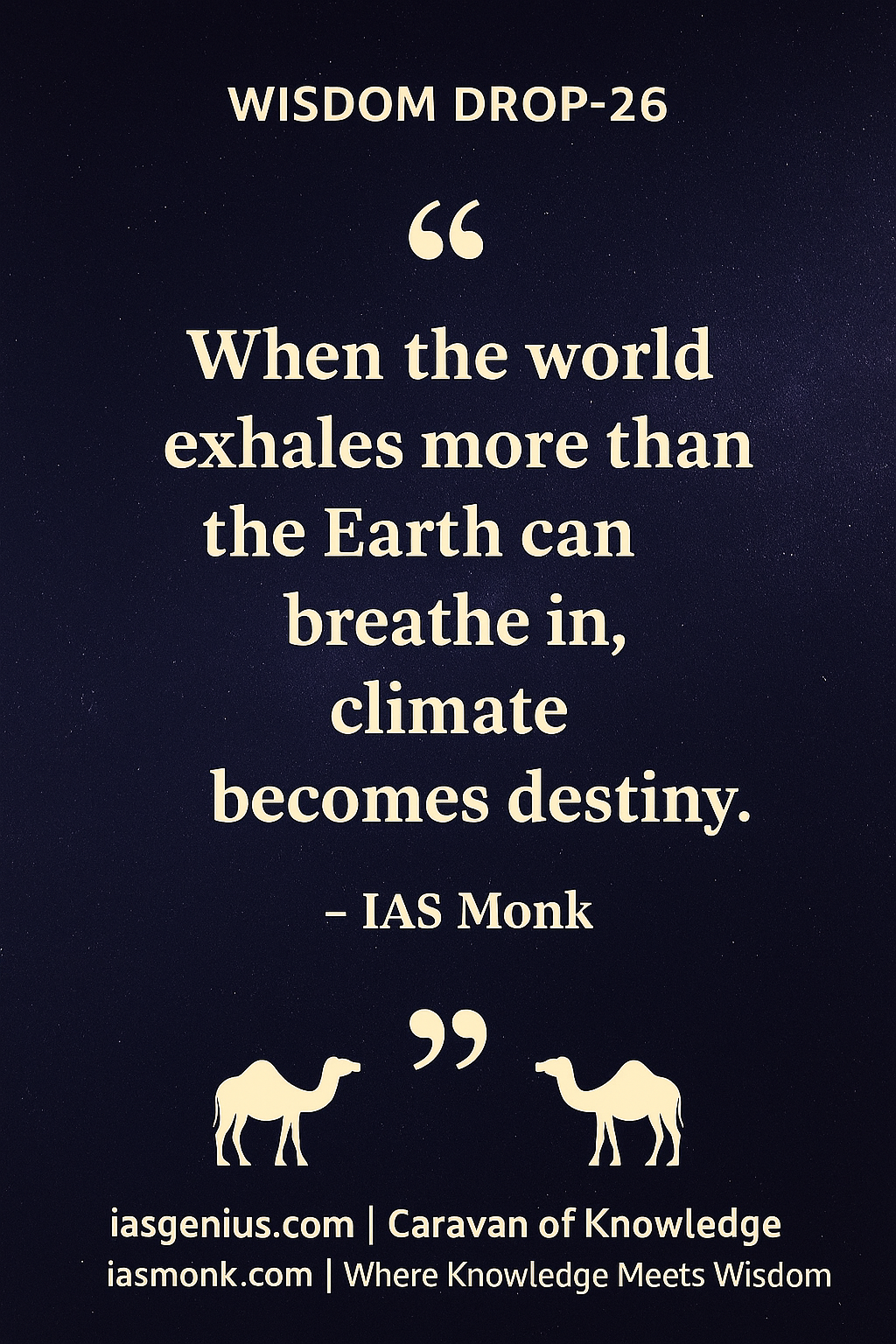
  • 🌑Wisdom Drop-26 : Philosophical Reflections : ON Knowledge Drops :“When the world exhales more than the Earth can breathe in, climate becomes destiny.” — IAS Monk

    🌑Wisdom Drop-26 : Philosophical Reflections : ON Knowledge Drops :“When the world exhales more than the Earth can breathe in, climate becomes destiny.” — IAS Monk

    🌑 WISDOM DROP-26

    “When the world exhales more than the Earth can breathe in, climate becomes destiny.” — IAS Monk

    The Reflection

    Global emissions are rising again.
    Not because the planet is cruel,
    but because humanity has not yet learned
    that progress without balance
    is merely acceleration toward a wall.

    The Global Carbon Project’s latest warning is not a statistic —
    it is a mirror held up to civilisation.

    A 1.1% global rise in emissions,
    India’s modest +1.4%,
    China’s +0.4%,
    America’s +1.9%,
    Europe’s +0.4% —
    numbers that look small until you realise
    they are measured in billions of tonnes of breath
    that the Earth must swallow.

    Every tonne of carbon is a decision.
    Every rise is a philosophy.
    Every delay is a silent approval
    of a hotter, harsher, narrower future.

    The Paris target of 1.5°C is not slipping away —
    it is waiting for humanity
    to decide whether it really wants
    a future worth inheriting.

    And in this choice lies the wisdom of our age:
    Progress is meaningless if the planet collapses under its weight.

    We do not inherit the Earth from our ancestors;
    we sculpt it for our children.

    Let every emission saved
    be an act of courage.
    Let every policy made
    be an act of remembrance.
    Let every citizen choosing sustainability
    be an act of quiet rebellion.

    Because climate is not a chapter in science —
    it is the biography of our civilisation.

  • 🌑Wisdom Drop-25 : Philosophical Reflections : ON Knowledge Drops :“A nation’s harvest begins not in the field, but in the seed.” — IAS Monk

    🌑Wisdom Drop-25 : Philosophical Reflections : ON Knowledge Drops :“A nation’s harvest begins not in the field, but in the seed.” — IAS Monk

    🌑 WISDOM DROP-25

    “A nation’s harvest begins not in the field, but in the seed.” — IAS Monk

    A seed looks small, almost forgettable — a fragment of dust in the palm. Yet inside it sleeps a civilisation. Every harvest, every market, every grain that fills a home begins with this quiet spark of life buried beneath the soil. And it is here, in this almost invisible moment, that a nation’s destiny takes root.

    The Draft Seeds Bill, 2025 does not simply reform an agricultural law; it rewrites the ethics of trust between the farmer and the system that feeds him. For decades, farmers have gambled their seasons on seeds whose quality they could not verify, whose promises dissolved in the first failed germination. A single counterfeit seed can collapse an entire year of labour — and sometimes an entire life.

    What, then, does a nation owe its farmers?
    Not slogans. Not sympathy.
    But certainty.

    The new Bill seeks precisely that — a world where every seed carries an assurance, where every dealer stands accountable, where transparency replaces chance. In a country where the soil remembers every betrayal and every blessing, the seed becomes more than a commodity; it becomes a covenant.

    Modern agriculture demands more than rainfall and resilience — it demands fairness. And when the law protects the smallest unit of agriculture, it protects the largest collective dream of a nation.

    For in the quiet journey from seed to field, from field to granary, from granary to life — the future of India grows leaf by leaf, root by root.

    IAS Monk

  • 🌑Wisdom Drop-24 : Philosophical Reflections : ON Knowledge Drops :“Borders breathe differently when trust becomes a bridge.” — IAS Monk

    🌑Wisdom Drop-24 : Philosophical Reflections : ON Knowledge Drops :“Borders breathe differently when trust becomes a bridge.” — IAS Monk

    🌑 WISDOM DROP-24

    “Borders breathe differently when trust becomes a bridge.” — IAS Monk

    Between India and Nepal, rivers flow, mountains stand, and histories intertwine — but nations do not move forward through geography alone. They move when two neighbours decide to widen the path between them, when trade becomes more than trucks and paperwork, when a road becomes a corridor of mutual destiny.

    In the quiet diplomacy of the Jogbani–Biratnagar rail link, an old truth reappears: progress does not always arrive with grand speeches; sometimes it arrives on a single track of steel, carrying the weight of shared futures. Nepal, landlocked but never land-limited, finds a deeper opening to the world — one that India has widened not out of strategy alone, but out of a commitment shaped by time, proximity, and civilizational kinship.

    Partnership is not built in sudden leaps but in steady expansions — a treaty amended, a route liberated, a port extended, a handshake renewed. And as the Himalayas watch silently, India and Nepal inch forward, rediscovering that cooperation is the most ancient trade route between them.

    For in South Asia, borders may divide terrain, but trust decides the journey. And whenever trust grows, nations do not merely trade goods — they trade possibilities.

    IAS Monk

  • 🌑Wisdom Drop-23 : Philosophical Reflections : ON Knowledge Drops :“Sometimes a nation strengthens itself not by holding ground, but by letting go of ground that no longer serves its deeper design.”- IAS Monk

    🌑Wisdom Drop-23 : Philosophical Reflections : ON Knowledge Drops :“Sometimes a nation strengthens itself not by holding ground, but by letting go of ground that no longer serves its deeper design.”- IAS Monk

    🌑 Wisdom Drop – 023

    In spite of Strategic Loss in Central Asia, India Withdraws from Ayni Airbase; Why?

    🌬️ Intro Whisper — IAS Monk

    “Sometimes a nation strengthens itself not by holding ground, but by letting go of ground that no longer serves its deeper design.”


    WD-23 — Poetic Reflection

    For nearly twenty-five years, at the edge of Central Asia, India kept a quiet footprint at Ayni — a lonely but resolute outpost in Tajikistan where mountains, great empires and shifting ambitions meet. Built in the Soviet era and abandoned after the USSR’s collapse, the airbase found a second life when India restored its runway, raised its hangars, and placed its faith in a strategic horizon that stretched across Afghanistan, Pakistan, and the restless expanse of Xinjiang.

    Ayni was more than an airstrip. It was a vantage point, a symbol of intent, a small but steady reminder that India’s gaze extended beyond the plains of the subcontinent. From there, India supported the Northern Alliance; from there, evacuations were planned; from there, the tremors of Afghanistan’s shifting fate were observed. For a moment in history, India’s Sukhoi-30s roared across the Tajik sky, and a quiet confidence settled into the high desert air.

    But geopolitics is a river that never stops moving.

    Russia tightened its grip over Central Asia, China expanded its shadow through new roads, new investments and new military footprints, and Afghanistan slipped once again into the uncertainty of the Taliban. In this landscape of shifting loyalties and silent recalibrations, Ayni’s relevance slowly thinned — not in symbolism, but in strategic usability. When the space to operate shrinks, presence becomes posture, and posture becomes unnecessary weight.

    And so India stepped back. Quietly. Without fanfare. Without farewell.

    Withdrawal was not defeat; it was adjustment. Not retreat; but re-alignment. Sometimes, a nation must unclench its fist not because it has lost what it held — but because it must now reach for something else. India’s strength today lies in expanding its ocean reach, building resilient partnerships, deepening its space-based intelligence, and shaping its neighbourhood with new instruments of influence. In that broader design, Ayni became a beautiful chapter — but not a permanent requirement.

    The airbase remains in Tajikistan; India’s spirit moves elsewhere.

    And as the winds of Central Asia continue their eternal journey across the valleys of Badakhshan and the rugged shoulders of the Pamirs, one truth remains: great powers are not defined by the ground they cling to, but by the future they choose to walk toward.

  • 🌑Wisdom Drop-22 : Philosophical Reflections : ON Knowledge Drops :“Only by listening to the Sun do we learn how fragile our little world truly is.”— IAS Monk

    🌑Wisdom Drop-22 : Philosophical Reflections : ON Knowledge Drops :“Only by listening to the Sun do we learn how fragile our little world truly is.”— IAS Monk

    🕊️ WISDOM DROP-22

    “Only by listening to the Sun do we learn how fragile our little world truly is.”
    — IAS Monk


    🌑 Philosophical Reflection on KD-22

    Aditya–L1 Tracks Coronal Mass Ejections (CMEs): India Enters the Frontline of Space Weather Wisdom

    For thousands of years, humanity worshipped the Sun as a god.
    Today, we study it as a star.
    But in truth, the Sun is both —
    a divine furnace of creation
    and a violent engine of destruction.

    And now, for the first time in history,
    India has placed its eyes close enough to witness the Sun not as myth,
    not as metaphor,
    but as a living system we must understand to protect our own.

    Aditya–L1 sits at Lagrange Point-1 like a monk meditating on the horizon of fire —
    1.5 million km away,
    neither too far to be blind
    nor too close to be burnt.

    From that sacred vantage point,
    India has just observed something the world has never seen in visible light:
    the birth-signature of a Coronal Mass Ejection.

    A CME is not a mere solar explosion.
    It is a cosmic exhale
    a breath of magnetized plasma hurled through space
    capable of shaking satellites,
    disrupting communication,
    tilting power grids,
    and rewriting the stability of modern civilization.

    When the Sun sneezes,
    the Earth shivers.

    And yet, in this turbulence lies wisdom.

    Because to understand the Sun’s violence
    is to understand our own vulnerability.

    To measure a CME’s temperature, speed, composition, and magnetic structure
    is not just scientific progress —
    it is the first step toward humility.
    A reminder that our entire technological world
    hangs by a thread illuminated by sunlight.

    Aditya–L1 is not a mission.
    It is a message.

    A message that sovereignty is not only on land or sea,
    but also in space.

    A message that as India prepares for Gaganyaan,
    for Venus,
    for lunar bases,
    for deep-space observatories —
    the Sun will either be our greatest guide
    or our greatest threat.

    But most importantly,
    it is a message that even the most ancient forces,
    forces we once prayed to,
    must now be understood with reason and responsibility.

    The Sun is no longer just a symbol.
    It is a system —
    one whose heartbeat shapes our own.

    And India has placed a stethoscope upon that heartbeat.


    ✨ Closing Whisper — IAS Monk

    “To protect the Earth, one must first learn to interpret the language of the stars.”

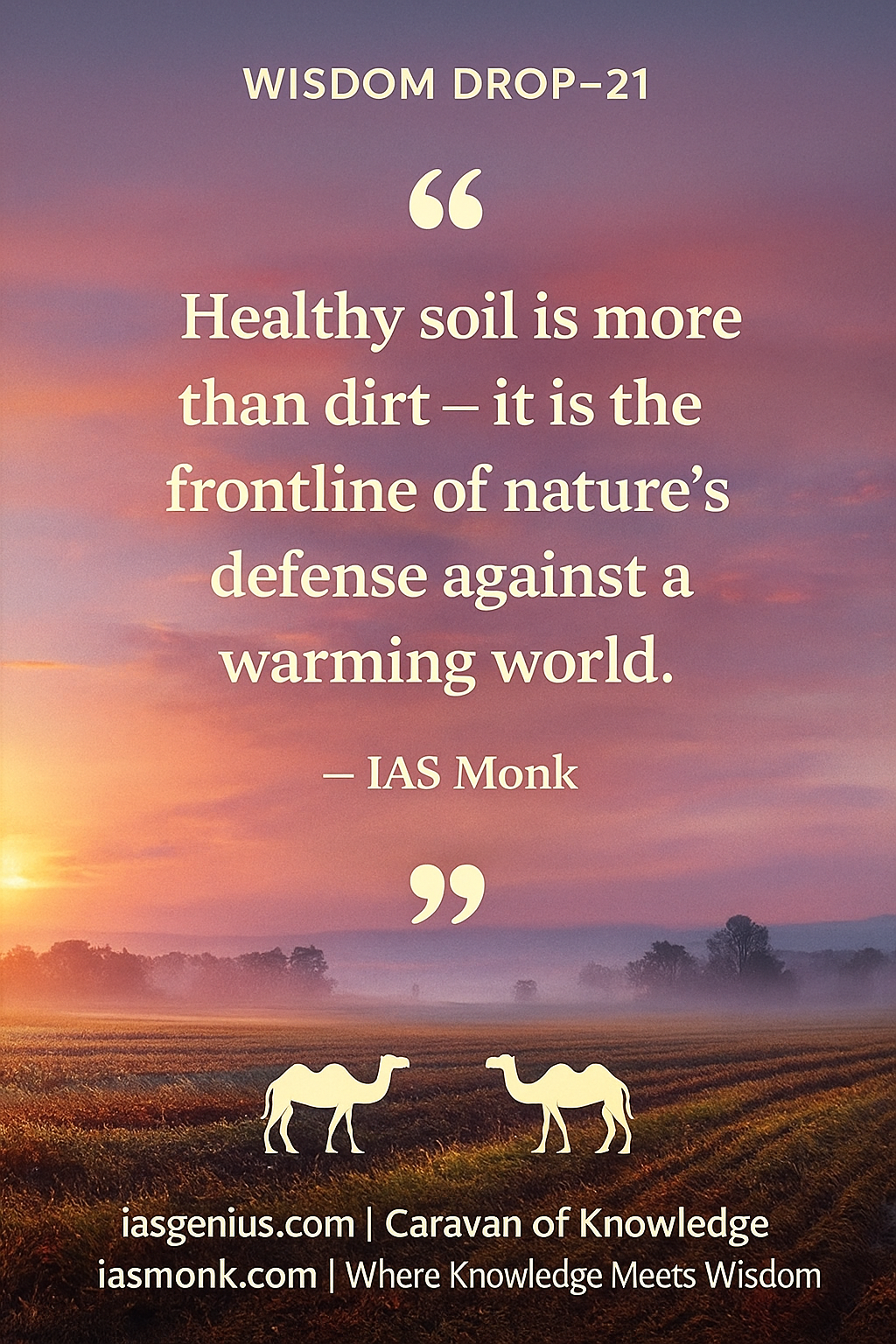
  • 🌑Wisdom Drop-21 : Philosophical Reflections : ON Knowledge Drops :“The soil forgets nothing — it returns exactly what we give it.”— IAS Monk

    🌑Wisdom Drop-21 : Philosophical Reflections : ON Knowledge Drops :“The soil forgets nothing — it returns exactly what we give it.”— IAS Monk

    🕊️ WISDOM DROP-21

    “The soil forgets nothing — it returns exactly what we give it.”
    — IAS Monk


    🌑 Philosophical Reflection on KD-21

    Soil Health in Peril: How Climate Change & Fertiliser Imbalance Are Emptying India’s Carbon Wells

    Soil is not dirt.
    It is memory.
    It remembers every monsoon we delayed, every chemical we overused, every crop we forced upon it, and every silence with which we ignored its fatigue.

    The ICAR findings are not just a scientific alert —
    they are a moral reminder that the ground beneath our feet is alive, and it is hurting.

    For decades, we believed that productivity comes from more fertiliser,
    while the truth is: productivity comes from more life in the soil.

    But life needs carbon —
    and carbon is disappearing.

    Punjab and Haryana, once symbols of India’s agricultural pride, now reveal another truth:
    even the most fertile lands can become deserts if we mistake speed for sustainability.

    Urea is abundant.
    Organic matter is not.

    Chemical fertilisers feed the crop.
    Carbon feeds the earth.

    And climate change is the silent thief accelerating the robbery.
    Rising temperatures burn carbon faster.
    Erratic rainfall washes it away.
    Heat dries the soil — and the soil, in return, dries the future.

    But the deepest wisdom lies in this:

    “When the soil loses carbon, a nation loses time.”

    Because rebuilding soil carbon is not a season’s task.
    It is the labour of years — sometimes decades.

    Hilly regions hold more carbon because they rest.
    Agricultural plains lose carbon because they are never allowed to breathe.

    We took from the soil what we did not replenish.
    We extracted harvests without returning harmony.
    We sought yield without remembering the relationship.

    But if destruction has a pattern,
    so does healing.

    Biochar.
    Green manures.
    Crop rotation.
    Zero-till.
    Organic amendments.
    Balanced fertiliser use.
    Trees that anchor carbon.
    Watersheds that hold moisture.
    Soil microbes that resurrect the invisible web of life.

    The land does not ask for miracles.
    Only memory —
    that we remember what it once was,
    and what it still can be.

    And if we choose wisely,
    India’s carbon wells can fill again.


    🌾 Closing Whisper — IAS Monk

    “The fertility of a civilization is measured not by the crops it grows, but by the care it gives to its soil.”


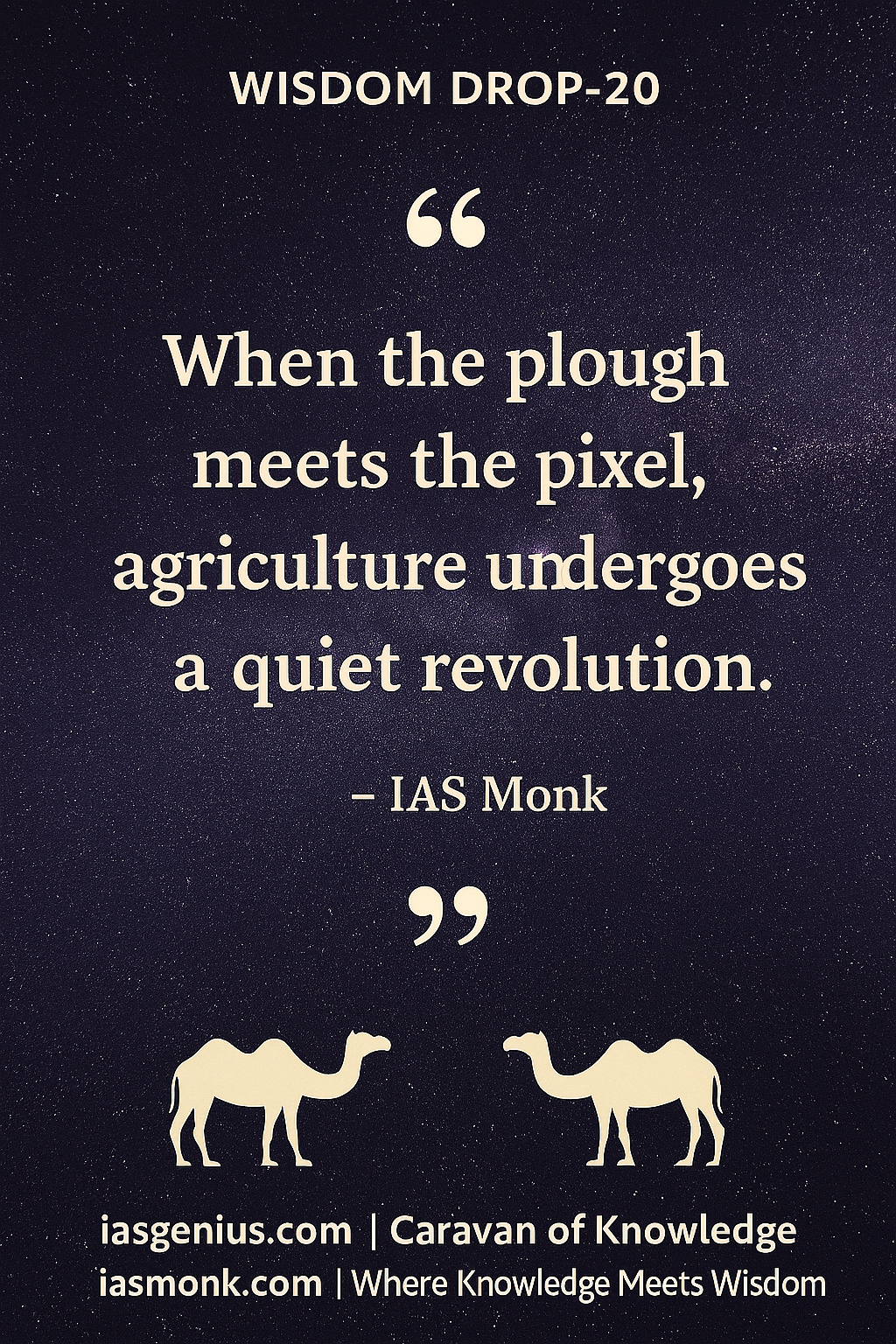
  • 🌑Wisdom Drop-20 : Philosophical Reflections : ON Knowledge Drops :“Where the plough meets the pixel, the future begins.”— IAS Monk

    🌑Wisdom Drop-20 : Philosophical Reflections : ON Knowledge Drops :“Where the plough meets the pixel, the future begins.”— IAS Monk

    🕊️ WISDOM DROP-20

    “Where the plough meets the pixel, the future begins.”
    — IAS Monk


    🌑 Philosophical Reflection on KD-20

    Shaping the Deep-Tech Revolution in Agriculture
    (WEF’s New Blueprint)

    When technology enters a field, it does not merely increase yield —
    it changes the destiny of the hands that till it.

    For centuries, agriculture has been defined by rain, soil, seed, and toil.
    But today, a seventh force has entered the equation —
    intelligence that does not grow in the earth, but in silicon.

    The World Economic Forum’s deep-tech blueprint is not just a policy document.
    It is a civilizational signal:
    that agriculture is no longer the “past” of an economy —
    it is the laboratory of the future.

    Generative AI is no longer predicting poems — it predicts pests.
    Computer Vision no longer sees faces — it sees leaf disease before a farmer does.
    Drones no longer make videos — they spray with millimeter precision.
    Satellite imagery no longer maps borders — it maps the stress of crops.
    CRISPR no longer edits genomes for curiosity — it edits the hunger equation.
    Nanotech no longer sits in a lab — it flows through the soil.

    And in a world of climate shocks, rural migration, soil fatigue, and water disappearance —
    deep-tech is not luxury.
    It is the last insurance policy for global food security.

    But here lies the Wisdom Drop:

    “Technology can save agriculture only if it does not replace the soul of agriculture.”

    The plough and the pixel must rise together —
    not one against the other.

    The farmer must not become the servant of algorithms.
    The algorithm must become the servant of the farmer.

    And when that equilibrium is struck —
    India will not just mechanise agriculture;
    it will re-imagine it.

    Because revolutions do not always come from machines.
    Sometimes, they come from the mind that decides how a machine should be used.

    And in that silent decision lies the future of food, freedom, and human dignity.


    🌾 Closing Whisper — IAS Monk

    “When a seed begins to think, a civilization begins to rise.”

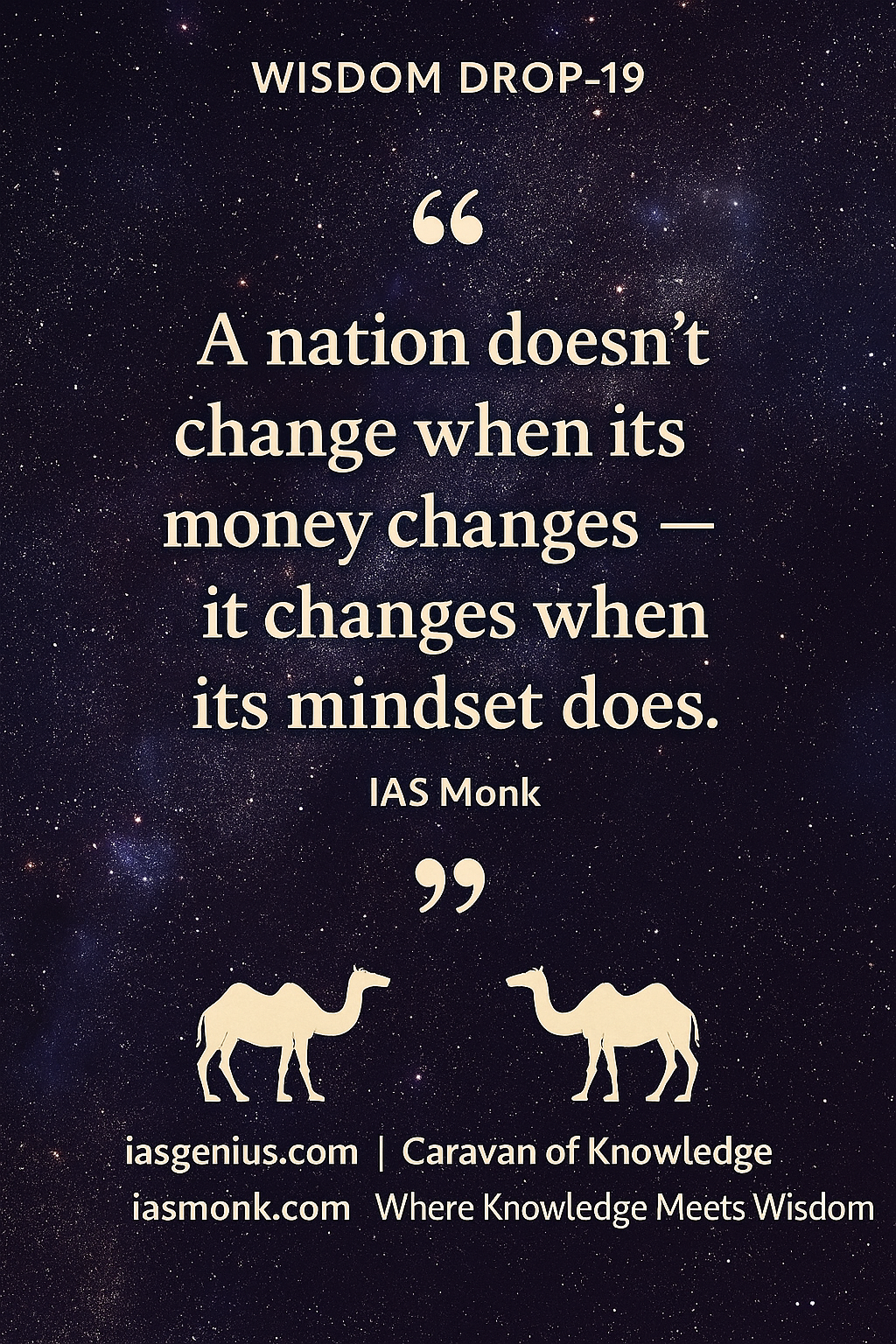
  • 🌑Wisdom Drop-19 : Philosophical Reflections : ON Knowledge Drops :A nation doesn’t change when its money changes — it changes when its mindset does”- IAS Monk

    🌑Wisdom Drop-19 : Philosophical Reflections : ON Knowledge Drops :A nation doesn’t change when its money changes — it changes when its mindset does”- IAS Monk

    “A nation doesn’t change when its money changes — it changes when its mindset does.”

    IAS Monk

    The Wisdom Behind Knowledge Drop-19

    Demonetisation at 9 years is not a story of currency —
    it is a story of consequences.

    A nation paused, businesses stalled, people queued — yet beneath the disruption, a silent shift began:
    India learned to live without cash.

    The reform did not erase black money, but it did something more enduring:
    it forced a civilisation trained for centuries in “cash-first survival” to reimagine trust, identity, and transaction in digital terms.

    The greatest revolutions are not financial — they are behavioural.


    The Monk’s Reflection

    There are two kinds of change:

    1. The sudden change that shocks a society.
    2. The subtle change that reshapes it.

    Demonetisation was the first.
    The rise of digital India was the second.

    The first caused pain.
    The second created possibility.

    And the truth we often forget is:

    Disruption is rarely the goal — it is the doorway through which transformation walks.


    A Closing Whisper

    When money becomes invisible, honesty becomes measurable.
    When systems modernise, mindsets must follow.
    And when a nation learns to trust its own digital shadow,
    it begins to walk with a new kind of power.